





The Telomere Effect: A Revolutionary Approach to a Younger, Healthier, and Longer Life
9.99 €
Out of stock

The Telomere Effect: A Revolutionary Approach to a Younger, Healthier, and Longer Life
9.99 €
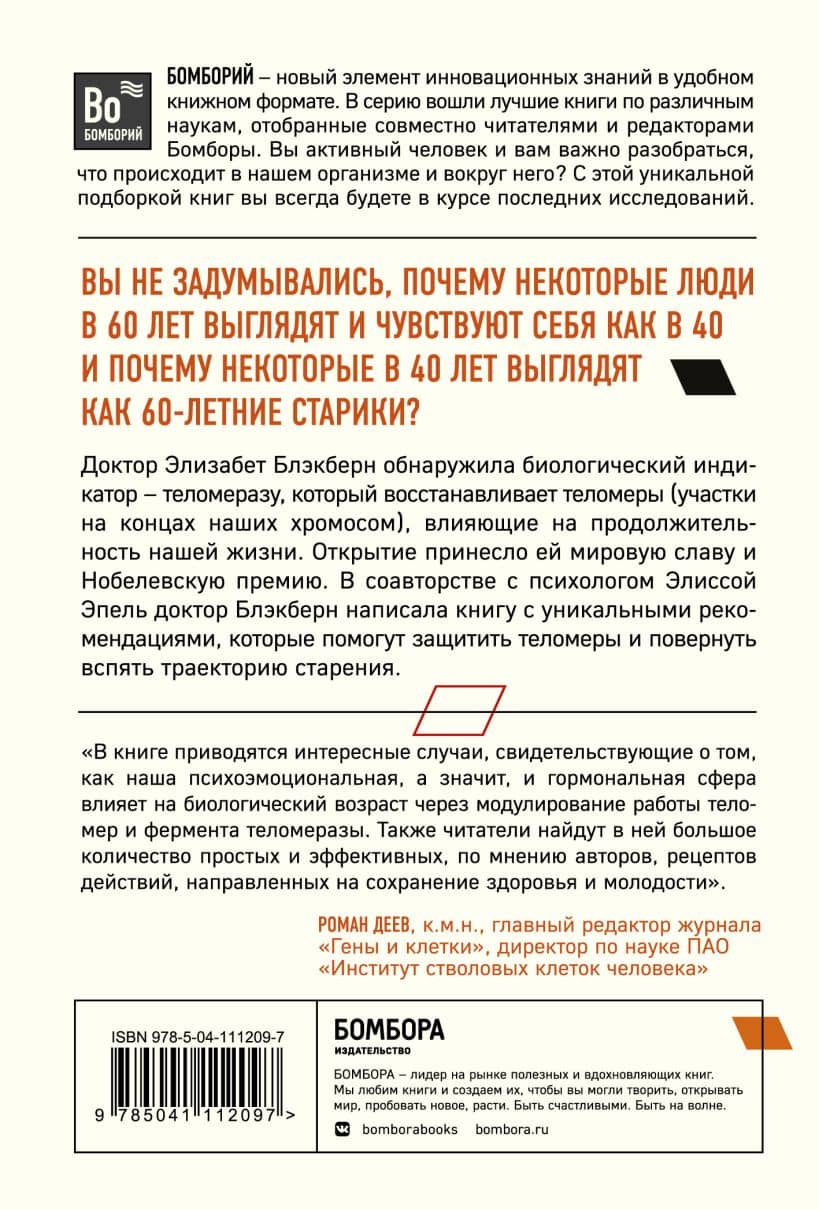
For life to continue, the body's cells must continually divide, creating exact copies of themselves—young and vibrant. These, in turn, begin to divide. This continues for decades, and the body causes us no particular trouble... And then, suddenly, we begin to age. But why? After all, cells are constantly being renewed, and theoretically, we could live forever! If this doesn't happen, then there must be a stern overseer within us who, at a certain point, declares, "Time to retire," and the obedient cells stop dividing. Sounds far-fetched? American cytogeneticist Elizabeth Blackburn discovered this "overseer" and thoroughly studied its mechanism, for which she received the Nobel Prize in Physiology or Medicine in 2009.
It turns out that telomeres—tiny sections of DNA at the ends of chromosomes—are responsible for our youth and longevity. They don't carry useful genes, and at first, it was unclear what their purpose was. Elizabeth Blackburn discovered that telomeres act as the biological clock of cellular aging. Telomere length determines how long a cell can divide. With each division, a cell strives to pass on intact genetic code to its "descendants," sacrificing small sections of telomeres to "take the hit." Simply put, each chromosome becomes slightly shorter on both ends as its telomeres shorten. Sooner or later, telomeres become too short, leaving the cell unprotected and unable to divide. Old age sets in.
Fortunately, telomere shortening is a manageable process. We can slow it down, pause it, and even reverse it! Elizabeth Blackburn and psychologist Elissa Epel have dedicated many years to finding ways to improve health and prolong youth. Not magical rejuvenating apples, but real, simple, yet effective methods that anyone can use—completely free and without excessive effort.
It turns out that telomeres—tiny sections of DNA at the ends of chromosomes—are responsible for our youth and longevity. They don't carry useful genes, and at first, it was unclear what their purpose was. Elizabeth Blackburn discovered that telomeres act as the biological clock of cellular aging. Telomere length determines how long a cell can divide. With each division, a cell strives to pass on intact genetic code to its "descendants," sacrificing small sections of telomeres to "take the hit." Simply put, each chromosome becomes slightly shorter on both ends as its telomeres shorten. Sooner or later, telomeres become too short, leaving the cell unprotected and unable to divide. Old age sets in.
Fortunately, telomere shortening is a manageable process. We can slow it down, pause it, and even reverse it! Elizabeth Blackburn and psychologist Elissa Epel have dedicated many years to finding ways to improve health and prolong youth. Not magical rejuvenating apples, but real, simple, yet effective methods that anyone can use—completely free and without excessive effort.
See also:
- All books by the publisher
- All books by the author
- All books in the series Bomborius. A New Element of Knowledge